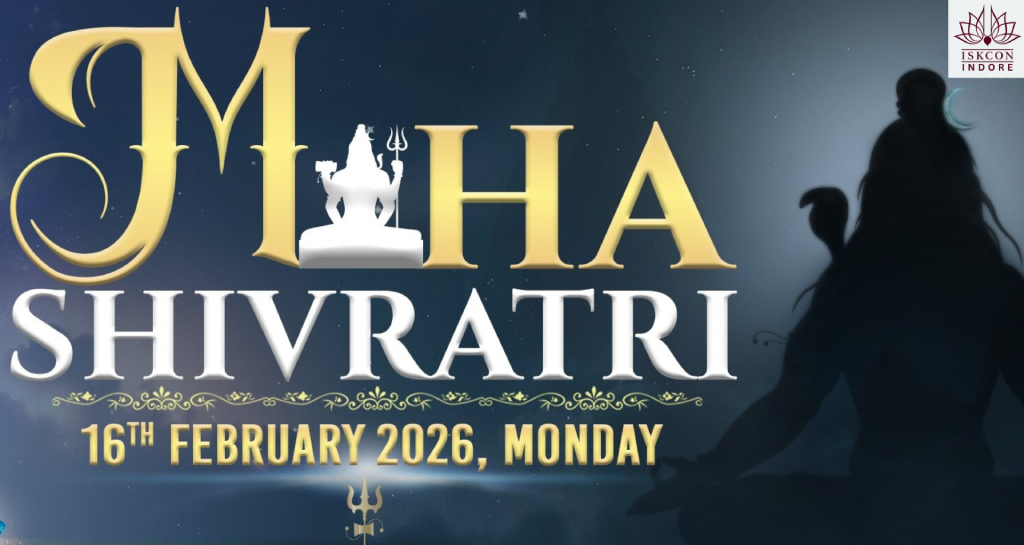
Auspicious Night of Worship to Lord Siva
Shivratri, also known as Maha Shivratri, is one of the most important and widely observed festivals dedicated to Lord Siva, who is honored as one of the greatest devotees of Lord Krishna. In 2026, this sacred occasion will be observed on February 16. Devotees fast, worship Lord Siva with devotion, and meditate on his divine qualities, remembering his deep service to the Supreme Lord.
Understanding the Significance of Shivratri
Shivratri means The Night of Lord Siva. According to the Puranas and Vaishnava teachings, Lord Siva is not a demigod in competition with Krishna, but the greatest Vaishnava, the topmost servant of the Supreme Lord. His appearance, teachings, and austerities all set an example of deep devotion and surrender.
In the Bhagavatam, it is described that Lord Siva constantly chants the holy names of Krishna and meditates upon His lotus feet. Therefore, Vaishnavas honor Lord Siva with great respect on this day, not as the Supreme God, but as the greatest devotee.
Why ISKCON Devotees Observe Shivratri
Srila Prabhupada taught that we must respect all devotees of Krishna, and Lord Siva is the topmost devotee. Therefore, observing Shivratri becomes a chance to:
· Remember the example of true devotion and humility
· Pray for pure service to Krishna, just as Lord Siva performs
· Offer respect to a powerful spiritual personality who assists conditioned souls
· Meditate on Srila Prabhupada’s instruction: “Vaishnavas never disrespect Lord Siva. We worship him as the greatest devotee.”
Recommended Devotional Practices on Shivratri
· Fasting (upavasa) either full fast or fruit and milk fast according to one’s capacity
· Chanting Hare Krishna Mahamantra continuously or with increased rounds
· Offering prayers such as “Vaishnavanam Yatha Sambhu” meaning “Among all Vaishnavas, Sambhu (Siva) is the greatest”
· Hearing from Srimad Bhagavatam, especially Canto 4 and Canto 8, where Lord Siva’s devotion is described
· Reading the teachings of Srila Prabhupada on Lord Siva
· Avoiding worship of Siva as the Supreme God, and instead remembering him as Krishna’s dear servant
Shivratri at ISKCON Indore
ISKCON INDORE observes Shivratri with devotion in a Vaishnava mood. The temple presents a spiritual atmosphere where Lord Siva is remembered as:
– The protector of Vrindavan
– The guardian of the dhama (Sri Gopeshvara Mahadeva)
– The one who grants entrance to Krishna’s pastimes to sincere devotees
Celebration highlights include:
1. Special Bhagavatam Class glorifying Lord Siva’s surrender to Krishna
2. Kirtan and bhajans focused on the holy names of the Lord
3. Offering of fruits, milk, and sacred water to Gopeshvara Mahadeva in the proper Vaishnava way
4. Evening kirtan and meditation on the holy pastimes of Lord Siva in Vrindavan
5. Fasting and prasadam distribution for all devotees at the end of the day
Lord Siva in Vrindavan – Gopeshvara Mahadeva
In Vrindavan, Lord Siva takes the form of Gopeshvara Mahadeva, the protector of the holy land of Vrindavan. He stands at the entrance of Krishna’s pastimes, granting spiritual qualification to sincere devotees. It is said that without the blessings of Lord Siva, no one can enter the true mood of Vrindavan bhakti.
Therefore, Vaishnavas pray:
“O Gopeshvara Mahadeva, please make me a servant of the servants of the gopis and bless me with pure devotion to Sri Sri Radha Krishna.”
Teachings of Srila Prabhupada on Maha Shivratri
Srila Prabhupada explained:
· “We respect Lord Siva as the greatest devotee of Krishna.”
· “A Vaishnava never disrespects Lord Siva. We offer him proper honor, not as the Supreme, but as the topmost Vaishnava.”
Thus, Shivratri is a day for spiritual reflection, humility, respect, and deeper commitment to bhakti.
Conclusion
Shivratri is not only a festival of austerity, but a celebration of pure devotion, surrender, and spiritual wisdom. By honoring Lord Siva properly, devotees receive blessings to progress on the path of Krishna consciousness.
Join us at ISKCON INDOE on February 16, 2026, to take part in kirtan, fasting, scriptural readings, and prayerful remembrance of Lord Siva, the eternal servant of Krishna.